
Headphone amplifiers · Product spotlight
Topping DX3 Pro+: a compact centre for desktop listening
A desktop DAC and headphone amplifier with USB, optical, coaxial and Bluetooth inputs. Check the output connections first.
Researched
Our recommendation
Useful for wired headphones and powered speakers fed from digital sources. It is not an analogue recording interface, a Bluetooth headphone transmitter or a power amplifier for passive speakers.
- Headphone output
- 3.5mm unbalanced stereo
- Digital inputs
- USB-B, optical, two coaxial and Bluetooth
- Speaker connection
- Stereo RCA line/preamp output; powered speakers or separate amplifier required
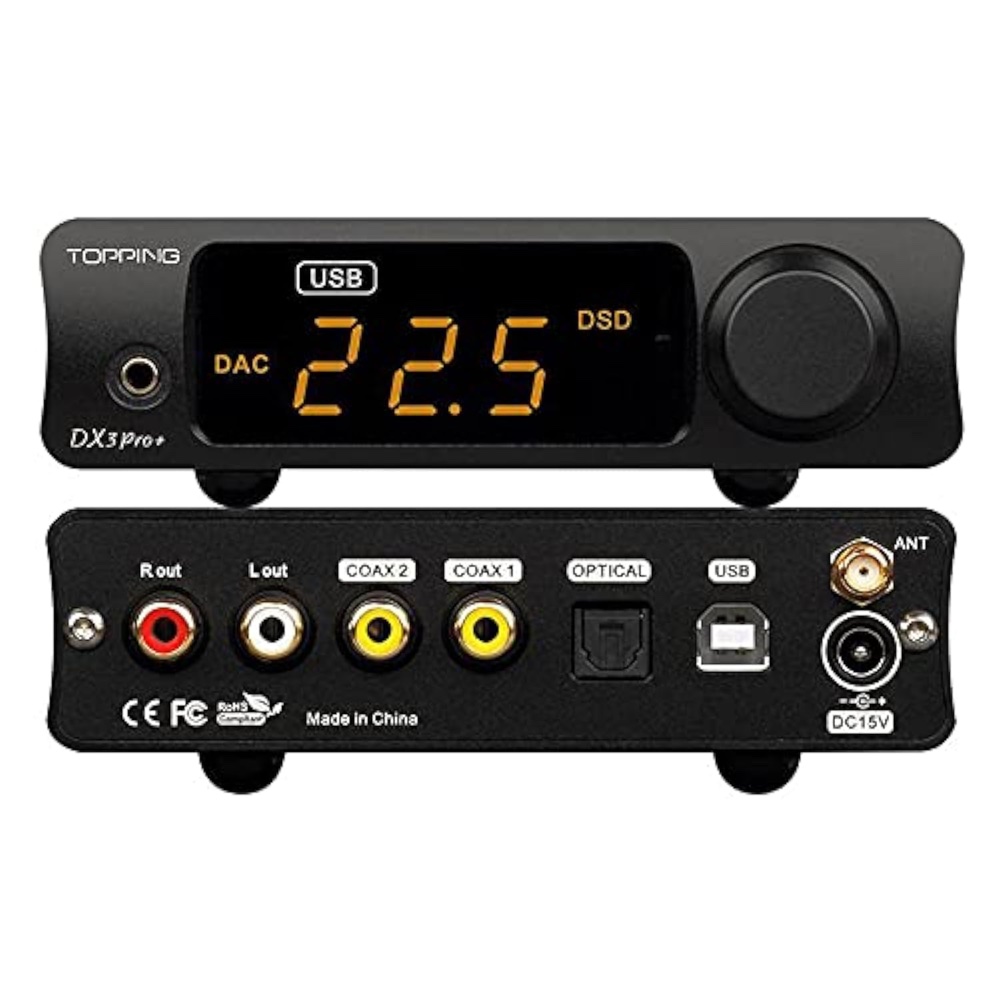
One black DX3 Pro+; the product photograph shows front and rear views of the same unit.
Affiliate links may earn us a commission. Check the exact variant and current price. Specifications are manufacturer claims, not our own test results.
Start with the output you need
DX3 Pro+ brings digital sources to a wired headphone socket and stereo RCA outputs. It can simplify a desk where a computer, digital player and powered speakers share one listening position.
The Amazon photograph presents front and rear views, not two units. The selected finish is black. Topping is the manufacturer; the listing’s Fanmusic brand field reflects the seller presentation rather than a different DAC design.
Match headphones beyond impedance
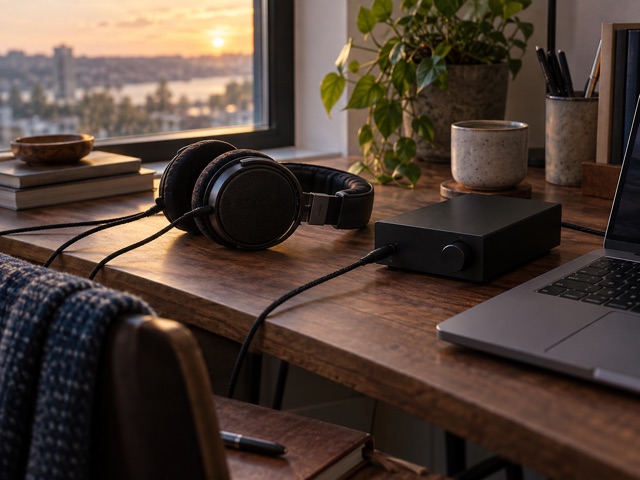
The headphone output is a conventional 3.5mm connection. Check the plug on your cable before ordering an adapter, and use the appropriate unbalanced connection. There is no balanced headphone output.
Impedance alone does not describe how much power a headphone needs; sensitivity matters too. Start with low gain and a low volume. The published power figures include a distortion condition, and we have not independently measured noise or output behaviour.
Choose the right digital path
USB accepts the highest advertised sample rates, while optical and coaxial have lower limits. Those decoding ceilings describe file compatibility, not a guaranteed audible benefit from larger files.
Bluetooth receives music from a phone or another source. It does not send music onward to wireless headphones. Codec availability depends on the sending device; an iPhone will not gain LDAC simply because the receiver supports it.
Plan the speaker connection
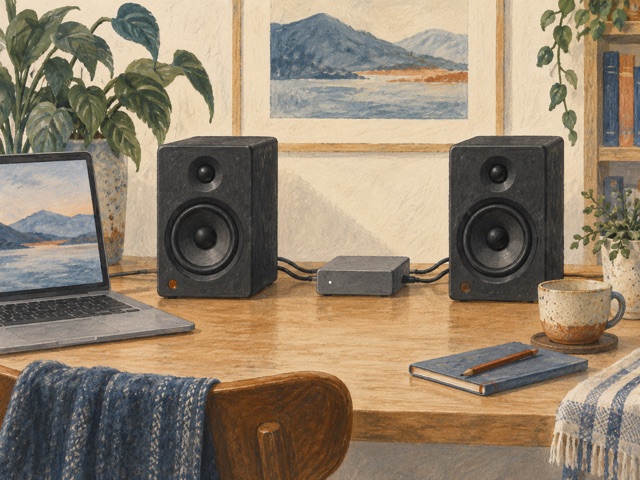
The RCA sockets feed powered speakers or a separate amplifier. In preamp mode, the unit controls their level; fixed DAC mode serves a system with its own volume control. Check that mode before playback.
The listing also mentions a separate PA3s amplifier. Its speaker-power figures do not describe DX3 Pro+. A pair of passive speakers cannot be connected directly to this DAC’s line outputs and expected to play.
Keep listening separate from recording
The supplied kit includes its DC adapter, remote, USB cable and Bluetooth antenna. Optical, coaxial and RCA cables depend on your setup. Leave enough depth behind the enclosure for their connectors.
Choose DX3 Pro+ for digital playback and wired listening. Someone recording microphones, connecting an analogue instrument or building a balanced speaker chain needs different connections. This is a researched guide; no listening comparisons or laboratory measurements were performed.
Technical details
Specifications and compatibility.
| Specification | Details |
|---|---|
| Headphone output | 3.5mm unbalanced stereo |
| Digital inputs | USB-B, optical, two coaxial and Bluetooth |
| Speaker connection | Stereo RCA line/preamp output; powered speakers or separate amplifier required |
| Linked version | Black DX3 Pro+; B09HBS8SLJ |
| DAC / Bluetooth chips | ESS ES9038Q2M / Qualcomm QCC5125 |
| Bluetooth | 5.0 receiver; SBC, AAC, aptX, aptX LL, aptX HD and LDAC |
| USB PCM | 16–32-bit, 44.1–768kHz |
| USB DSD | DSD64–512 native; DSD64–256 DoP |
| Optical / coaxial | 16–24-bit PCM to 192kHz; DSD64 DoP |
| Headphone power at 32 ohms | 1.8W per channel, THD+N below 0.1% |
| Headphone power at 64 ohms | 0.9W per channel, THD+N below 0.1% |
| Headphone power at 300 ohms | 0.25W per channel, THD+N below 0.1% |
| Headphone output impedance | Below 0.1 ohm |
| Gain | 6dB or 19dB |
| Manufacturer headphone load | Above 8 ohms; sensitivity also matters |
| RCA output level | 2.1Vrms at 0dBFS |
| RCA output impedance | 20 ohms |
| Output modes | Headphones, headphones plus line, fixed DAC output or variable preamp |
| Power | 15V DC / 1A supplied adapter; consumption below 6W |
| Dimensions | 120 × 165 × 40mm |
| Weight | 420g |
| Box contents | One unit, power adapter, remote, USB cable, Bluetooth antenna, manual and warranty card |
| Separate cables | RCA, optical/coaxial and headphone adapters as required |
| No analogue input | No microphone, instrument or turntable input |
| No passive speaker drive | RCA output requires powered speakers or a separate power amplifier |
A good fit if…
You want one digital playback hub for wired headphones and a powered speaker system.
Keep in mind
No analogue input, balanced output or passive speaker amplification. Bluetooth receives audio; it does not transmit to headphones.