
2 perspectives. One decision.
RØDE NT-USB+ vs HyperX QuadCast 2: focused recording or flexible pickup?
Two USB condenser microphones with desk stands. Compare monitoring, pickup patterns, processing and room setup.
Researched · Specification comparison
The short answer
NT-USB+ suits solo voice or instrument recording with a pop filter and configurable processing. QuadCast 2 adds four pickup patterns, touch muting and a shock mount for a more flexible desktop setup.
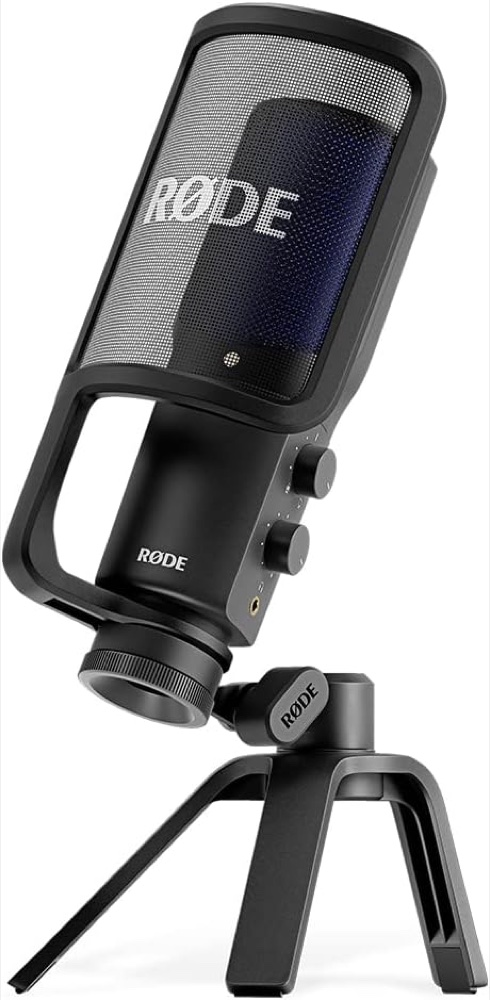
For solo recording
RØDE NT-USB+
One black NT-USB+ with pop filter, ring mount, tripod and SC29 cable; not the original NT-USB.
Check it out: RØDE NT-USB+ on Amazon.de (opens a new tab)Image: RØDE / Amazon.de product listing
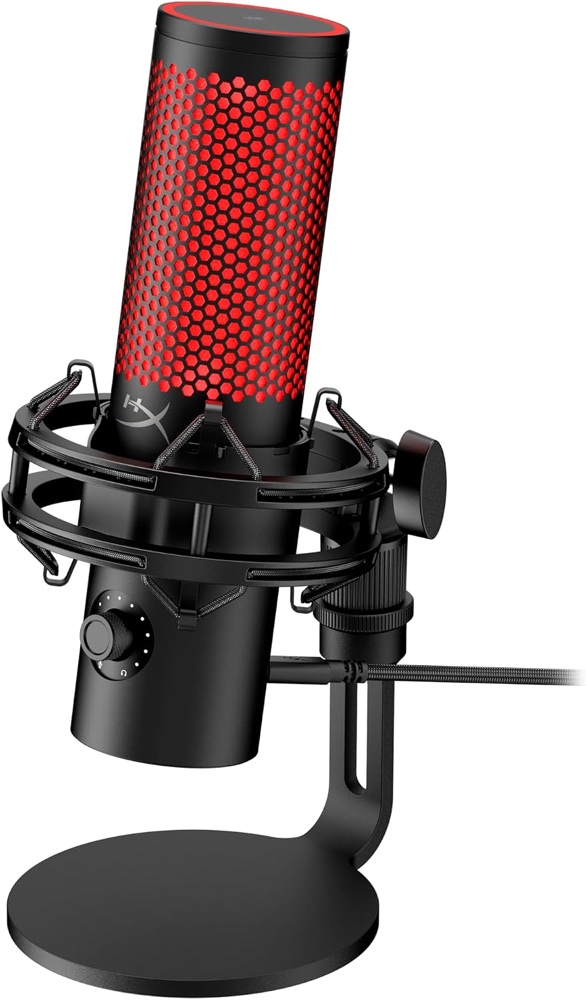
For varied recording arrangements
HyperX QuadCast 2
One black QuadCast 2 with red lighting, shock mount and desk stand; not QuadCast 2 S.
Check it out: HyperX QuadCast 2 on Amazon.de (opens a new tab)Image: HyperX / Amazon.de product listing
Affiliate links may earn us a commission. Compare the exact variant and current price before buying. Specifications are manufacturer claims, not our own test results.
Match pickup to the session
For one speaker, cardioid is a sensible starting point on either microphone: position the front toward your voice and keep a consistent distance. NT-USB+ keeps that choice simple. QuadCast 2 also offers bidirectional, omnidirectional and stereo settings for different arrangements.
A shared microphone still records the room and the balance between speakers. Extra patterns do not give each guest an independently adjustable recording track. Choose them for an actual seating or instrument arrangement.
Keep monitoring within reach
Both provide a headphone socket so you can hear the microphone directly. RØDE separates headphone level from the blend of microphone and computer sound. HyperX uses a multifunction dial for several settings.
QuadCast 2 adds a top touch-mute sensor and visible status lighting. Check the active input in your recording app after reconnecting either microphone. Monitoring your voice is useful, but it does not prove the application is recording the intended source.
Treat the room as part of the setup
A desk stand is included with each linked package. HyperX adds a removable shock mount; RØDE includes an external pop filter. Those accessories address different problems: desk vibration and bursts of breath.
Neither accessory removes room echo or fan noise. Bring the microphone closer, angle it to reduce breath blasts and record a short sample while the room is in normal use. Curtains and soft furnishings can be useful starting points, without guaranteeing a studio result.
Buy the correct generation
The checked RØDE link now identifies NT-USB+ with USB-C and 24-bit recording. Do not use the original NT-USB’s 16-bit specifications. HyperX is QuadCast 2 with red lighting, not the higher-specification QuadCast 2 S.
HyperX specifies a USB-C cable plus USB-A adapter; Amazon’s summary describes the cable differently. Confirm the supplied connection if your computer has only one port type. Neither microphone includes an analogue XLR path.
Choose useful controls over bigger numbers
QuadCast’s 96kHz option creates larger files and does not establish that speech sounds better than RØDE’s 48kHz recording. Placement, recording level and the application’s settings remain consequential.
Choose RØDE for focused solo work and configurable APHEX processing. Choose HyperX when touch muting and selectable pickup patterns simplify your sessions. We have not recorded comparative samples; personal voice quality and room performance remain untested.
Side by side
The differences that matter.
On smaller screens, swipe across the table to compare all products.
| At a glance | RØDE NT-USB+ | HyperX QuadCast 2 |
|---|---|---|
| Linked version | NT-USB+, black; B00MMKQOEM | QuadCast 2, black/red; B0D9MCK4R8 |
| Microphone design | Side-address condenser; pressure gradient | Side-address; three 14mm electret condenser capsules |
| Pickup patterns | Cardioid | Cardioid, omnidirectional, bidirectional and stereo |
| Recording resolution | 24-bit / 48kHz | 16/24-bit; 44.1, 48 or 96kHz |
| Microphone frequency range | 20Hz–20kHz | 20Hz–20kHz |
| USB connector | USB-C | USB-C; supplied USB-A adapter |
| XLR output | None | None |
| Headphone connection | 3.5mm; direct monitoring | 3.5mm; direct monitoring |
| Onboard controls | Headphone volume and microphone/computer monitor mix | Multifunction dial: gain, playback, monitoring and pickup pattern |
| Mute control | Use recording software; no touch-mute panel | Top tap-to-mute sensor |
| Audio processing | APHEX processing via compatible RØDE apps | NGENUITY settings; not the same APHEX processing suite |
| Lighting | No decorative lighting system | Red illumination and microphone status indication; not RGB 2 S |
| Mount supplied | Desktop tripod and ring mount | Desktop stand and removable shock mount |
| Pop protection | Detachable external pop filter included | Internal filter; additional external filter optional |
| Body / setup size | 184 × 62 × 50mm, microphone body | 116 × 156 × 268mm, manufacturer assembled dimensions |
| Weight | 540g microphone; 730g with accessories | 335g microphone; 819g total including cable |
| Power | USB bus power, 5V / 500mA | USB bus power, 5V / 240mA with lights on |
| Cable | SC29, 3m USB-C to USB-C | 3m USB-C to USB-C plus USB-A adapter, per manufacturer |
| Desktop support | Class-compliant USB; RØDE apps on supported Windows/macOS | PC and Mac; NGENUITY features require supported Windows software |
| Other hosts | Compatible iOS/Android devices; Lightning needs a suitable separately sold accessory cable | Manufacturer lists PS5, Nintendo Switch and Steam Deck; check app support |
| Additional equipment | Headphones; optional boom and compatible mobile cable | Headphones; optional boom or pop filter |