
Product spotlight
Netatmo Weather Station: understand conditions around your home
Explore the original station’s indoor and outdoor measurements, sensor accuracy, Wi-Fi requirements and optional expansion modules.
Researched · Researched buying guide
The short answer
We recommend the original Netatmo Weather Station for households that want to follow indoor conditions and local outdoor temperature and humidity in one app. It suits trend watching better than someone seeking a standalone display, an offline logger or included wind and rain measurement.
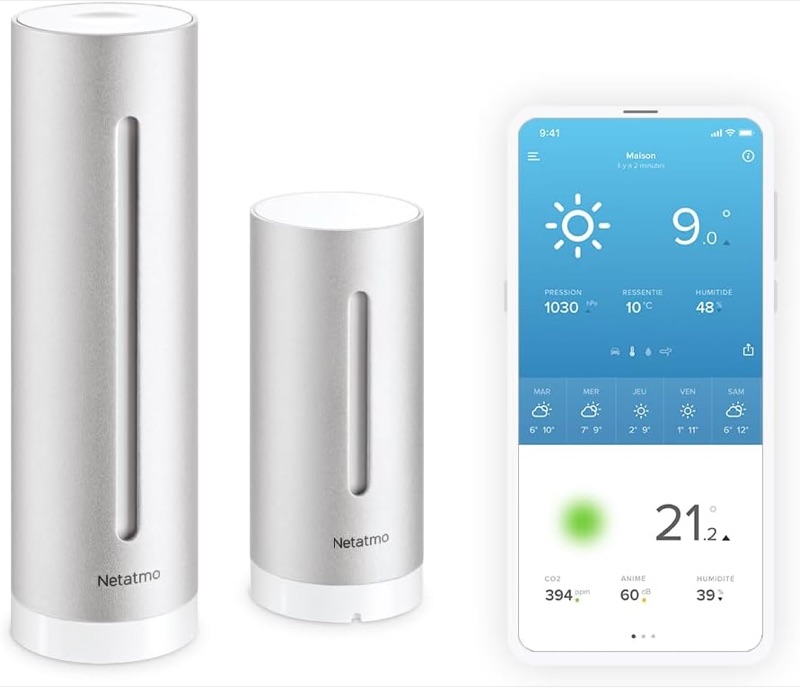
For indoor and outdoor trends
Netatmo Weather Station · original
Original silver indoor/outdoor station, NWS01-EC. This link is not for the second-generation station or a rain-and-wind bundle. Phone shown in the product image is not included.
Check it out: Netatmo Smart Weather Station on Amazon.de (opens a new tab)Image: Netatmo / Amazon.de product listing
Affiliate links may earn us a commission. Compare the exact variant and current price before buying. Specifications are manufacturer claims, not our own test results.
Local measurements answer a different question from a forecast
A weather forecast describes expected conditions over an area. This station records conditions at the places where you position its modules. That can help you understand why a particular room feels different from another or how your sheltered garden compares with the broader forecast.
The base kit includes one indoor module and one outdoor module. Indoor measurements cover temperature, humidity, carbon dioxide, pressure and ambient sound level; the outdoor module measures temperature and humidity. Rain and wind readings require separate accessories, so they are not part of the standard two-module purchase.
Position the outdoor module carefully
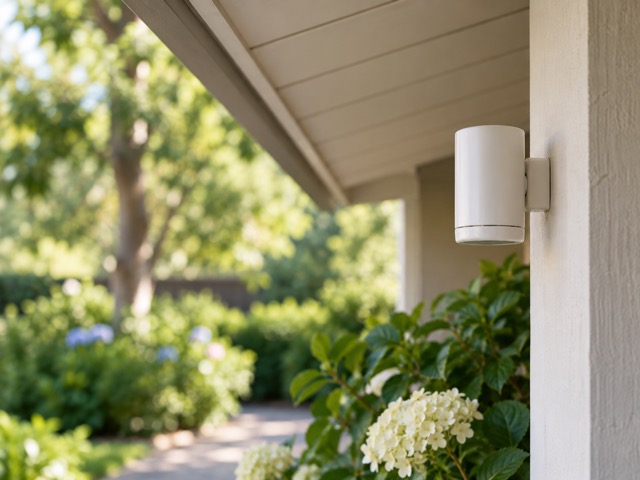
A sunny wall can heat a sensor beyond the surrounding air temperature, while a sheltered corner may behave differently from an exposed part of a garden. Follow Netatmo’s guidance on shade, protection from weather and airflow. The outdoor designation is not a reason to leave the module anywhere without considering its surroundings.
Check the radio connection before fixing a permanent location. Walls, metal and distance can affect communication with the indoor module. If outdoor readings disappear, investigate positioning, batteries and connection before treating the absence of data as an unusual weather event. The station measures the spot you chose, including its local influences.
Read ranges, accuracy and timing separately
The published temperature ranges are 0–50°C indoors and −40–65°C outdoors, with stated accuracy of ±0.3°C. Humidity covers 0–100% with ±3 percentage-point accuracy. Those figures describe different aspects of measurement: a wide operating range does not imply equally fine certainty about every displayed digit.
The station records measurements every five minutes. It is therefore useful for following changes over time, but it is not an instant-response instrument for every short event. We use the current manufacturer pressure range of 260–1160 mbar; older documents give a different upper limit, which should not silently replace today’s published specification.
Understand what the CO₂ reading represents
The indoor module reports carbon dioxide in parts per million. Netatmo quotes an accuracy of ±100 ppm up to 1000 ppm and ±10% above that level. Follow the manufacturer’s calibration guidance and allow the sensor to establish a useful baseline before interpreting a single reading as a precise description of the room.
Carbon dioxide is one measurement, not a complete inventory of indoor air quality. This station does not replace a smoke or carbon-monoxide alarm and does not measure every pollutant. Likewise, the ambient sound-level reading is a level measurement; do not confuse that feature with a promise to record intelligible audio or diagnose a noise problem.
Use trends to understand everyday changes

A useful first project is to follow how a room changes during normal occupancy, ventilation and heating. Look at several days of readings and note what was happening in the room. That gives the graphs context and helps avoid attributing every rise or fall to the most recent action.
Keep module placement consistent while comparing trends. Moving the indoor unit from a cool shelf to a sunny windowsill changes the measurement location as well as the conditions being measured. The generated illustration beside this section represents ventilation; it is not evidence of a measured improvement from this particular station.
Plan the connected setup and optional expansion
The indoor module uses mains USB power and connects through 2.4 GHz Wi-Fi. The European modules communicate over 868 MHz, while the outdoor unit uses two AAA batteries according to Netatmo’s current specification. The quoted battery life is up to two years, not a guaranteed replacement interval in every climate.
The normal connected experience uses a Netatmo account, app and internet access. Standard station features currently require no subscription. Before adding rain, wind or extra indoor modules, confirm compatibility with this original station and decide where the additional equipment will go. Review account and data-sharing settings as part of the initial setup.
Our recommendation: buy it for useful context
The original Weather Station is a good fit when you want a simple ongoing record of indoor conditions alongside local outdoor readings. It is particularly useful when you have a clear question about a room or location and can position the modules consistently enough to follow the answer over time.
Choose a different system if you need a dedicated console, offline data access or wind and rain sensors included from the start. This Amazon link is for the original silver station, not the second-generation model. Our guidance uses the current manufacturer specifications and support information rather than claiming independent sensor calibration or long-term testing.
Technical details
Specifications and compatibility.
| Specification | Details |
|---|---|
| Included measuring modules | 1 indoor module and 1 outdoor module |
| Indoor measurements | Temperature, humidity, CO₂, air pressure and ambient sound level |
| Outdoor measurements | Temperature and relative humidity |
| Measurement interval | Every 5 minutes |
| Indoor temperature range | 0 to 50°C; stated accuracy ±0.3°C |
| Outdoor temperature range | −40 to 65°C; stated accuracy ±0.3°C |
| Relative humidity | 0–100%; stated accuracy ±3 percentage points |
| Air pressure | 260–1160 mbar; stated accuracy ±1 mbar |
| Indoor CO₂ range | 0–5000 ppm |
| CO₂ stated accuracy | ±100 ppm up to 1000 ppm; ±10% above 1000 ppm |
| Ambient sound level | 35–120 dB |
| Home network | 2.4 GHz Wi-Fi, 802.11 b/g/n |
| Module radio link | 868 MHz for the European model |
| Indoor power | USB power adapter |
| Outdoor power | 2 AAA batteries; manufacturer quotes up to 2 years, depending on conditions |
| Indoor module dimensions | 45 × 45 × 155 mm |
| Outdoor module dimensions | 45 × 45 × 105 mm |
| App and account | Netatmo app/account and internet connection for the connected service |
| Optional expansion | Rain gauge, wind gauge and up to 3 additional indoor modules |
| Subscription | No subscription required for standard station features at research date |