
Oscilloscopes · Product spotlight
FNIRSI 1014D: an entry point for low-voltage bench signals
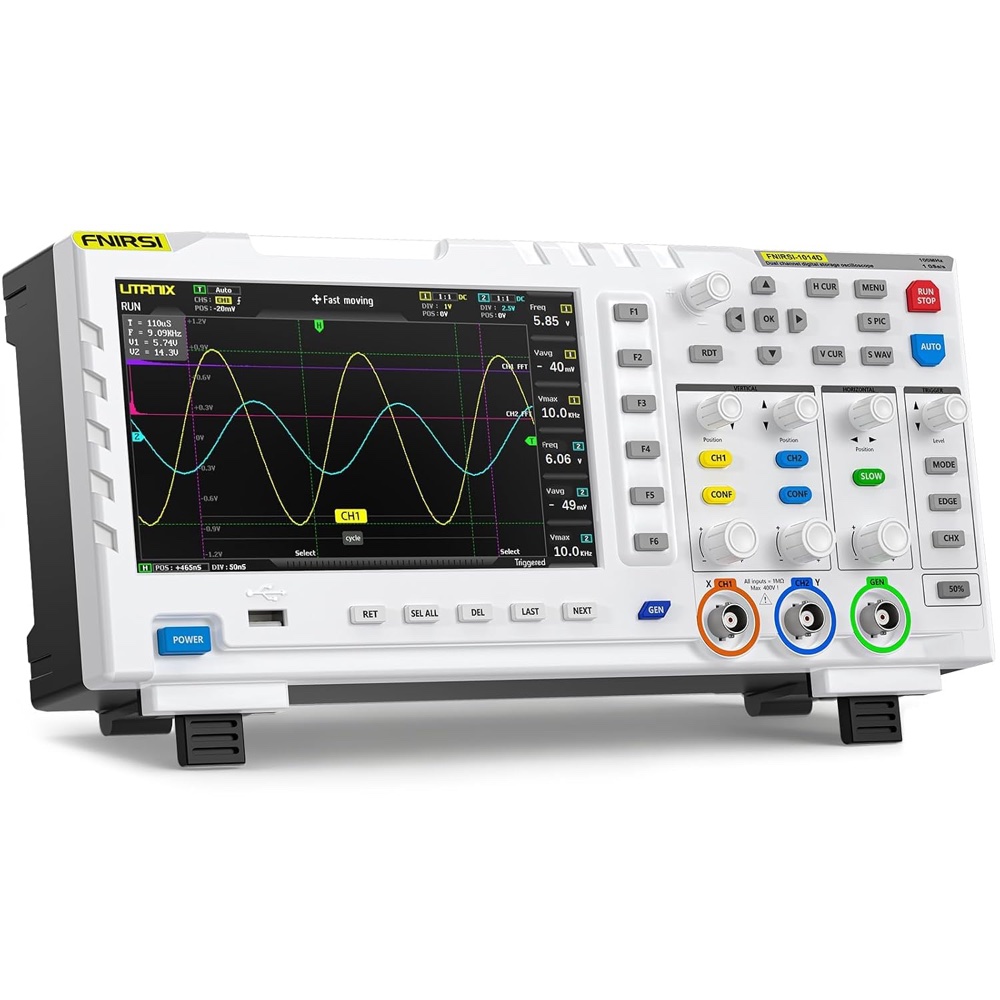
A two-channel bench oscilloscope with a basic waveform generator. Read the probe and documentation limits before choosing.
Researched
Our recommendation
Worth considering for learning on low-voltage circuits when a standalone display and basic generator are useful. Unresolved memory-depth claims and unverified performance make it unsuitable as a confidently specified precision instrument.
- Channels
- Two oscilloscope inputs plus one generator output
- Display
- 7-inch colour TFT, 800 × 480
- Claimed bandwidth
- 100MHz with suitable 10× probe; not independently measured
One standard white/grey 1014D, not 1014D Plus. The checked listing did not establish a complete accessory count.
Affiliate links may earn us a commission. Check the exact variant and current price. Specifications are manufacturer claims, not our own test results.
Choose a learning task first
1014D combines a two-channel oscilloscope and a basic signal generator in a standalone desktop instrument. It can be considered for observing low-voltage signals and learning how amplitude, frequency and triggering relate.
The link selects the standard white and grey 1014D. FNIRSI also sells a Plus version, so its name and specifications should not be mixed into this article. No independent bandwidth or sample-rate measurements were made for this guide.
Treat probes as part of the instrument
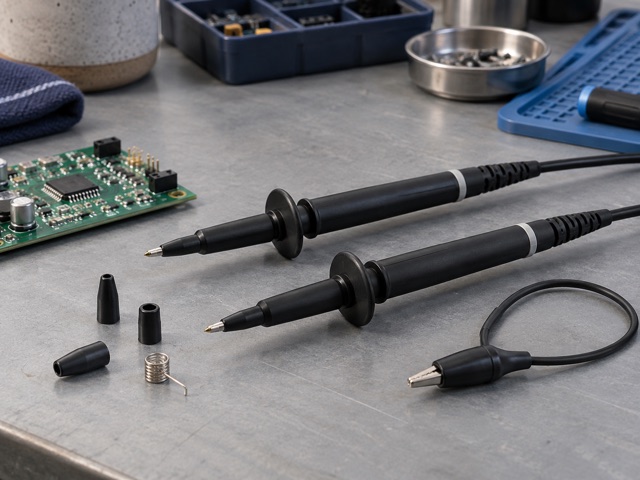
The manual states that a probe in 1× mode has much lower bandwidth than its 10× setting. Changing only the on-screen attenuation value does not change the physical probe. The two settings must agree.
Check the probe, ground connection and circuit before taking a reading. The channels share ground, so connecting their ground clips to different potentials can create a short. This guide is limited to low-voltage bench use.
Use the generator within its limits
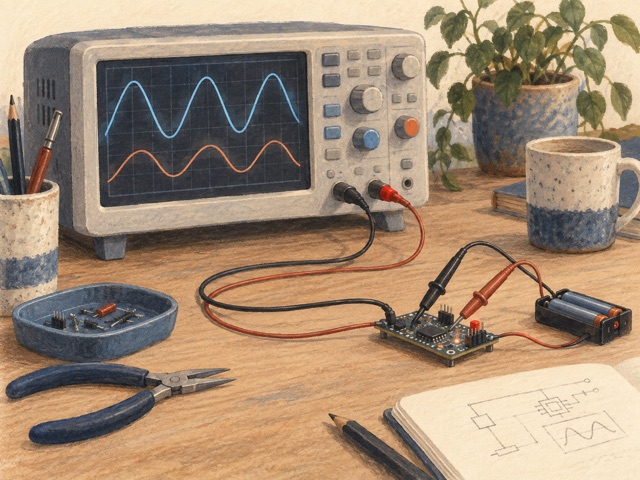
The built-in generator can provide standard and captured waveforms, making a simple signal source available without a second enclosure. Its fixed 2.5V peak-to-peak output is a meaningful limitation.
It is not equivalent to a laboratory generator with freely adjustable amplitude and offset. Start with a learning task that fits the documented output, and check the circuit’s input requirements. A waveform drawn on screen is not proof of signal fidelity.
Keep conflicting claims separate
Amazon’s title lists 240K points of memory; FNIRSI’s technical table lists 240Kbit. Those units are not interchangeable, and the available manual does not resolve the difference. Do not choose it around an assumed capture depth.
The manual specifies fourteen standard waveforms, despite conflicting product-page prose. We use the manual for that count. The supplied probe and accessory quantities were not clearly established from the selected listing and need confirmation.
Choose with realistic expectations
A large display and direct controls can suit a learning bench, but critical timing analysis or calibrated measurement requires stronger performance evidence than these published claims provide. The advertised voltage ceiling is not a verified measurement-category rating.
Use the specified original supply and read the manual before operation. The current download page restricts firmware updates to Windows 10 or 11 and warns against macOS. These requirements belong in the decision, not as surprises after purchase.
Technical details
Specifications and compatibility.
| Specification | Details |
|---|---|
| Channels | Two oscilloscope inputs plus one generator output |
| Display | 7-inch colour TFT, 800 × 480 |
| Claimed bandwidth | 100MHz with suitable 10× probe; not independently measured |
| Linked version | Standard FNIRSI 1014D; B0FMK5GGPH; not Plus |
| Claimed sample rate | 1GSa/s; manufacturer claim, not a measured effective rate |
| ADC resolution | 8-bit |
| Input impedance | 1 megohm |
| Input coupling | AC or DC |
| Probe factors | 1×, 10× and 100× settings; match the physical probe |
| Probe bandwidth caveat | Manual states 1× probe bandwidth is 5MHz; 10× mode needed above this |
| Trigger modes | Auto, normal and single; rising/falling edge |
| Analysis | FFT, XY display, voltage/time cursors and automatic measurements |
| Memory depth | Amazon title: 240Kpts; manufacturer table: 240Kbit; unresolved |
| Capture storage | Up to 1000 screenshots and 1000 waveform records, per manual |
| Export | USB sharing of saved screenshots and waveform data |
| Generator | One DDS output; 14 standard waveforms plus captured/custom waveform, per manual |
| Generator amplitude | 2.5V peak-to-peak fixed output; not a fully adjustable lab generator |
| Generator frequency | Manufacturer: sine to 10MHz, other waveforms to 2MHz, custom to 1MHz; 1Hz steps |
| Power | External 5V supply; use the original specified adapter, not a computer USB port |
| Battery | No built-in battery specified |
| Size | 310 × 145 × 70mm, manufacturer specification |
| Grounding | Channels share ground; never connect probe grounds to different potentials |
| Measurement category | No verified CAT rating established; guide limited to low-voltage bench work |
| Advertised voltage ceiling | Site lists 40V at 1× / 400V at 10×; not proof of safe mains use |
| Firmware update host | Manufacturer download page specifies Windows 10/11; do not update using macOS |
| Quantity / accessories | One scope selected; exact probe count, adapter and leads require seller confirmation |
A good fit if…
You want a standalone instrument for basic low-voltage learning and accept the documented generator and verification limits.
Keep in mind
Shared grounds; no verified CAT rating. Memory-depth units conflict, accessory count is unconfirmed, and advertised performance has not been independently measured.