
2 perspectives. One decision.
Fluke 117 vs UNI-T UT61E+
Compare two true-RMS multimeters through the work they suit: electrical troubleshooting, low-current electronics, display resolution and computer connectivity.
Researched · Specification comparison
The short answer
Fluke 117 is the clearer fit for electrical troubleshooting that benefits from AutoVolt and low-impedance voltage measurement. UNI-T UT61E+ offers finer display resolution and a broader electronics feature set, including USB communication. Choose by measurement requirements and the documented safety limits, not the largest number on the box.
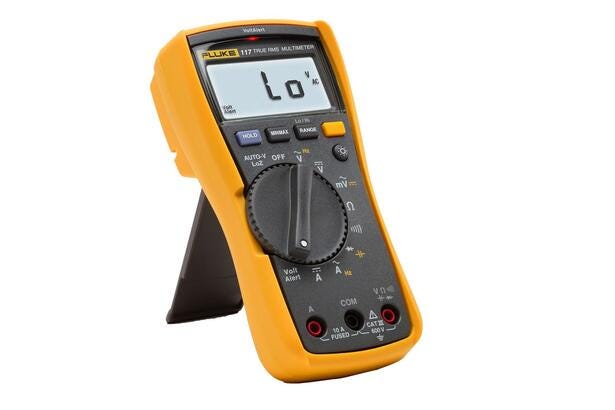
For electrical troubleshooting
Fluke 117
6,000-count electrician’s multimeter with AutoVolt, VoltAlert and LoZ. Standard meter, not a calibration-certificate bundle.
Check it out: Fluke 117 on Amazon.de (opens a new tab)Image: Fluke
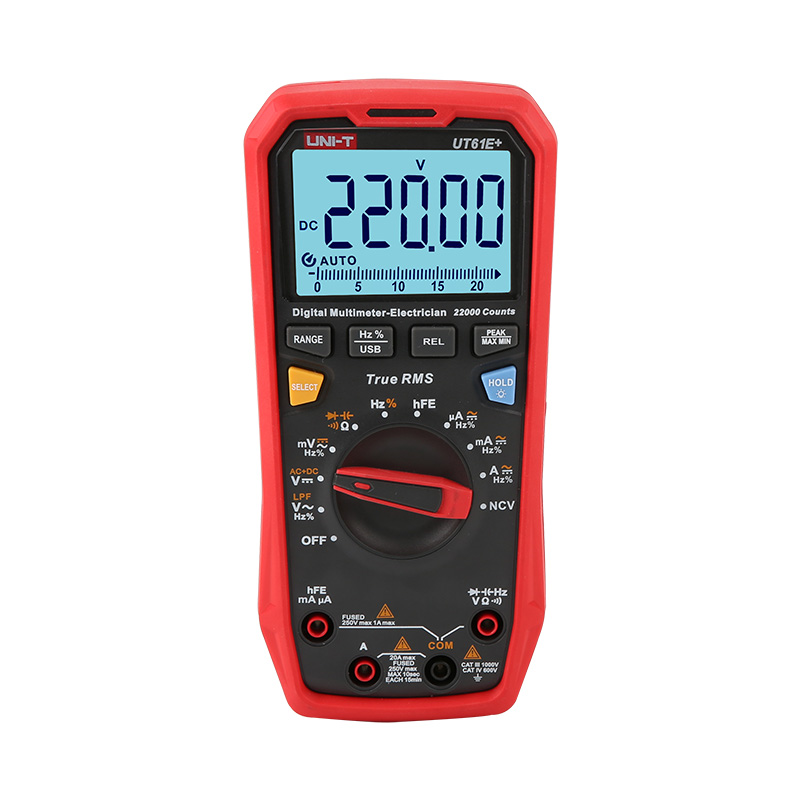
For electronics measurements
UNI-T UT61E+
22,000-count true-RMS meter. This is the E+ model, not the older UT61E or the D+ variant.
Check it out: UNI-T UT61E+ on Amazon.de (opens a new tab)Image: UNI-T
Affiliate links may earn us a commission. Compare the exact variant and current price before buying. Specifications are manufacturer claims, not our own test results.
Match the instrument to the measurement
A multimeter can answer many questions, but the right instrument depends on which questions you ask most often. Checking an electrical installation and characterizing a small electronic circuit place different demands on controls, ranges and input behavior. Fluke’s 117 is aimed at electricians. UNI-T’s UT61E+ provides a wider set of electronics-oriented functions and a higher-resolution display.
Begin with the voltage, current and component ranges you actually need, then consider the environment where the instrument will be used. More functions do not automatically make a meter better for a particular job. These are measurement tools, and the correct instrument, leads, procedure and operator knowledge must all fit the work.
Counts describe resolution, not complete accuracy
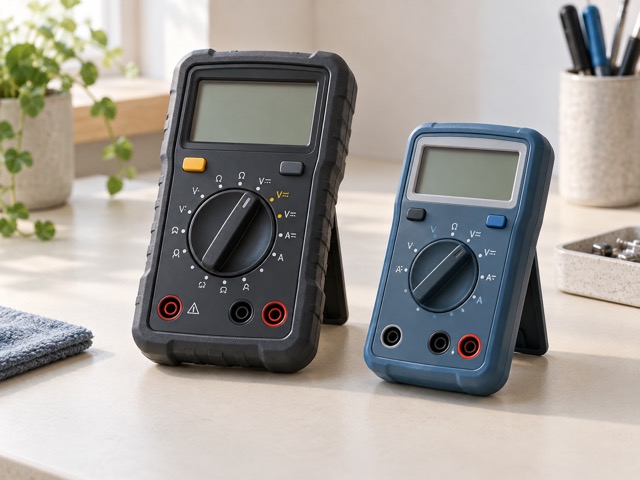
The 117 has a 6,000-count display and the UT61E+ has 22,000 counts. The larger count can reveal smaller changes before the meter moves to another range. That is useful when comparing low-voltage readings, but it does not mean every reading is proportionally more accurate. Resolution and accuracy describe different properties.
Published basic DC voltage accuracy is tighter for the UNI-T, but an accuracy statement includes both a percentage of the reading and a count term. The selected range affects the value of that count term. Frequency, temperature and other conditions also matter for applicable specifications. Compare the manual’s relevant range rather than carrying a headline percentage into every measurement.
Fluke’s controls address common electrical questions
AutoVolt selects between AC and DC voltage, while the low-impedance mode helps reduce misleading readings associated with capacitively coupled ghost voltages. Those are practical features for the electrical troubleshooting tasks the 117 targets. The tool’s value lies in presenting the relevant answer clearly, not in offering every possible bench measurement.
Low impedance is not a mode to use indiscriminately on sensitive electronics because the instrument can load the circuit being measured. The UT61E+ manufacturer table does not list LoZ for this variant; that feature appears for the D+ instead. Model suffixes matter here. Buying an E+ should not be based on a feature copied from another member of the series.
Small currents and component work separate them
The Fluke’s current range has a finest resolution of one milliamp. If you need to examine tiny standby currents or other low-current behavior, that can be a more decisive limitation than the display count. The UNI-T includes dedicated lower-current ranges and additional functions such as duty cycle and transistor hFE, giving it a broader role on an electronics bench.
Neither instrument replaces an oscilloscope for viewing fast-changing waveforms. Likewise, a high maximum frequency or capacitance range does not mean every component can be characterized accurately in every circuit. Define the signal and the uncertainty you can tolerate, then check the appropriate range, test conditions and limitations. It is often better to buy for a recurring task than a long list of rarely used modes.
A computer connection has practical conditions
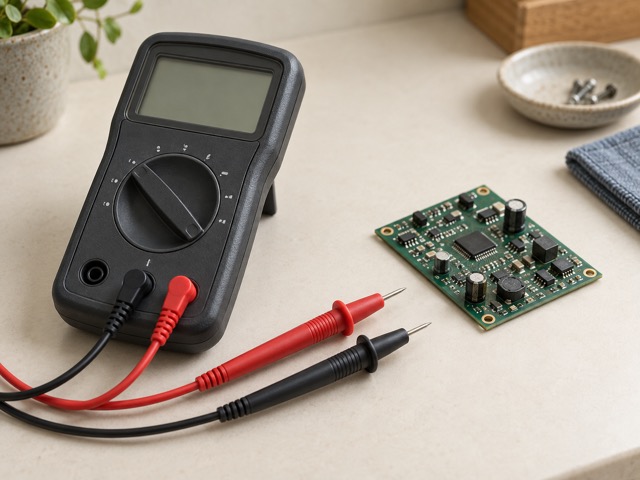
UT61E+ supports USB communication, making it worth considering when readings need to be recorded on a computer. Before relying on that feature, confirm the supplied interface, current manufacturer software and operating-system compatibility. A USB capability in the table is not a promise that a preferred Mac or mobile application can immediately read the instrument.
The 117 has no comparable USB data connection. For occasional spot readings, that may be irrelevant. For a repeatable logging workflow, it is a real distinction. Also consider how the instrument stands on the bench, whether the screen remains visible and how the leads reach the work without pulling the meter over. These small handling details affect daily usefulness.
Safety ratings and detection need careful interpretation
Fluke specifies CAT III 600 V for the 117. For either meter, use the exact manual and markings on the instrument and leads to establish the permitted measurement category and voltage. A maximum voltage range is not a universal safety rating for every electrical environment. The highest current range also has time and duty limits that must be respected.
VoltAlert and NCV provide non-contact indications, but a missing indication must not be treated as proof that a circuit is de-energized. Work on hazardous electrical systems belongs with appropriately trained people using the required verification procedures. This comparison explains purchasing differences; it does not establish that a meter makes an unfamiliar mains task safe to attempt.
Buy the right variant and support package
Choose Fluke 117 when its electrical troubleshooting controls are the features you will repeatedly use. Choose UNI-T UT61E+ when finer low-voltage readings, lower-current ranges and computer communication better match the bench work. Neither recommendation is based on our own laboratory accuracy or durability testing; those would require controlled measurements and appropriate reference equipment.
Check the exact model suffix, included leads, interface accessories and seller support before ordering. A standard 117 is not the same purchase as a separately specified calibration-certificate package. If your work requires traceable calibration, include that service in the total. Replacement leads and fuses must meet the manufacturer’s requirements rather than being chosen only because they physically fit.
Side by side
The differences that matter.
On smaller screens, swipe across the table to compare all products.
| At a glance | Fluke 117 | UNI-T UT61E+ |
|---|---|---|
| Display counts | 6,000 | 22,000 |
| True-RMS AC measurement | Yes | Yes |
| Maximum listed AC/DC voltage | 600 V | 1,000 V |
| Basic DC voltage accuracy | ±(0.5% of reading + 2 counts) | ±(0.05% of reading + 5 counts) |
| Current measurement emphasis | 10 A range; finest resolution 1 mA | Separate low-current ranges; up to 20 A with manual limits |
| Low-impedance voltage mode | Yes, AutoVolt/LoZ | Not listed for E+; D+ is a different model |
| Non-contact voltage detection | VoltAlert | NCV audible/visual alert |
| Resistance range maximum | 40 MΩ | 220 MΩ |
| Capacitance range maximum | 9,999 µF | 220 mF |
| USB communication | No | Yes |
| Additional electronics functions | Continuity, diode and frequency | Continuity, diode, frequency, duty cycle and transistor hFE |
| Battery type | One 9 V alkaline | Four AAA cells |